- 6th km Harilaou - Thermis, Thessaloniki, Greece

Bench Scale Units
PETROCAT has access to the following bench scale units of LEFH
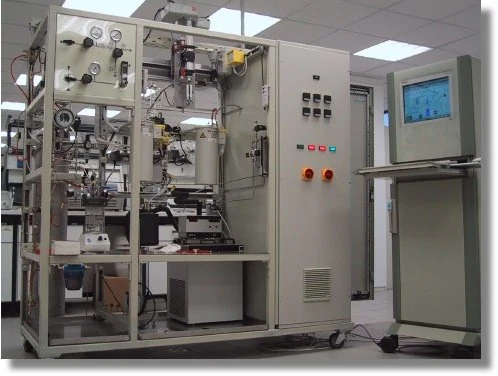
01 · Catalyst Evaluation
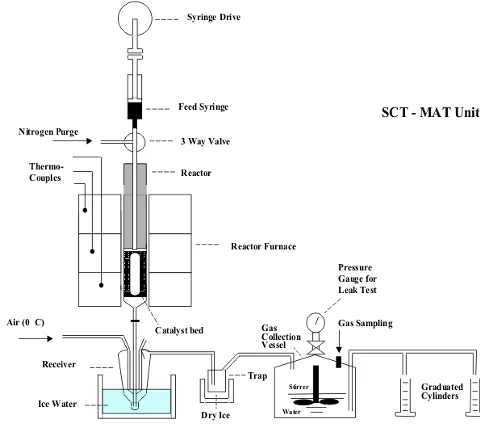
Fixed bed reactor for evaluation of cracking catalysts at short contact times (SCT-MAT)
The SCT-MAT reactor is made of Pyrex glass and it is heated by a three-zone furnace. Preheated feed (60 °C) is injected into the reactor through an oil capillary heated only by the oven, using a special motor pump. The reactor consists of an annular bed where the catalyst is diluted with inert glass beads.
The vapor products of the cracking are cooled to 0 °C at the reactor exit, where part of them are condensed and collected in a specially designed high volume liquid receiver. The remaining non-condensed gaseous products are led to a gas collection system (cylinders) and are collected by water displacement. Following the oil injection, N2 flows into the reactor in order to drive the products along the reactor.
One of the most important parameters which determine the yield, the quality of FCC products and in general the competitiveness of an FCC unit is the catalyst type. It is, therefore, important to be able to predict the effectiveness of an FCC catalyst with reliable laboratory tests, so that refineries can choose the most satisfactory catalyst.
| Product analysis | |
|---|---|
| Gaseous products | Refinery Gas Analyzer (HP-5890) |
| Gasoline | Capillary GC (HP 5880 A) |
| Coke on catalyst | Elemental Analyzer (Leco CHN-800) |
| Feed preheating | 60 °C |
| Product cooling | 0 °C |
| Reactor | Pyrex glass, annular bed |
| Furnace | 3-zone |
02 · Catalyst Deactivation
Steamer unit for bench scale samples
Two steamer units are available in LEFH for fresh FCC catalyst deactivation. Apart from steaming, the units can also be used as calcination units for the evaluation of equilibrium FCC catalysts. Each unit consists of a quartz fluid bed reactor heated by a 3-zone furnace. Temperature control is achieved with measurements from a thermocouple in the catalyst bed.
The one steamer is 75 cm high with a 6 cm diameter and accepts 150 g of fresh catalyst, while the second steamer accepts 3–5 kg of catalyst. The usage of each unit depends on the forthcoming step for catalyst evaluation (MAT or FCC pilot plant respectively). When used as a steamer, the fluidization stream is steam at 1450 °F; during calcination the fluidization stream is air at 1005 °F. The units are fully automated and steaming or calcination can be terminated after a desired period of time.
2steamer units
150 gsmall unit capacity
3–5 kglarge unit capacity
1450 °Fsteaming temperature
1005 °Fcalcination temperature
3-zonefurnace heating
03 · Catalyst Deactivation
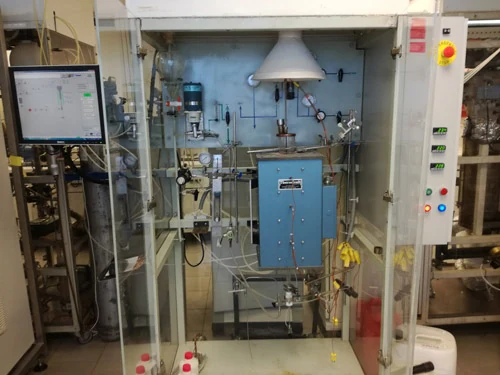
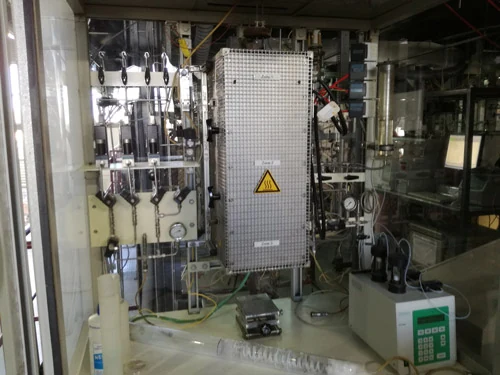
Cyclic Propylene Steaming (CPS) deactivation unit for bench scale samples
A large Cyclic Propylene Steaming (CPS) deactivation unit is available in LEFH for FCC catalyst deactivation. The unit is fully automated and consists of a metal fluid bed reactor heated by a 3-zone furnace. Temperature control is achieved with measurements from a thermocouple in the catalyst bed.
Metals are deposited on the catalysts following a standard wet impregnation method, and the catalyst is then loaded in the CPS unit for deactivation. A special protocol is applied using alternate oxidation-reduction cycles: the oxidation takes place with a mixture of air and the reduction with a mixture of propylene. Steam is always added in the unit for all cycles.
~5 kgFCC catalyst capacity
3-zonefurnace heating
Metalfluid bed reactor
Redoxalternating cycles
Steamin every cycle
Fullyautomated
04 · Catalyst Deactivation
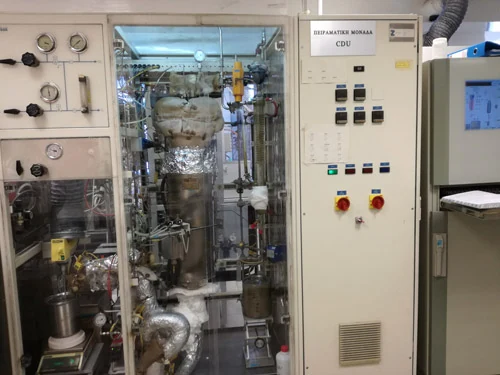
Continuous cyclic deactivation unit (CDU) for bench scale samples
The CPERI cyclic deactivation unit (CDU), designed by Xytel, is fully computerized and satisfactorily simulates E-cats by depositing metals on FCC catalysts. This laboratory method is considered to be the most widely accepted for FCC catalyst aging. The CDU mimics FCC catalyst deactivation in repeated cycles of cracking, stripping and regeneration.
LEFH follows a specific protocol where a complete CDU run consists of 54 cycles, each one including a cracking, a stripping and a regeneration step and lasting about 60 minutes. Regeneration is achieved with a mixture of O2 and N2.
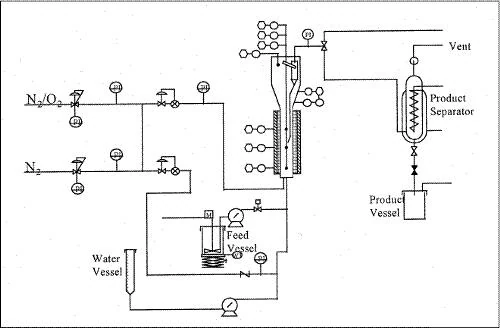
| CDU deactivation protocol | |
|---|---|
| Cycles per run | 54 |
| Duration per cycle | ~60 min |
| Cracking step | 500 °C · 50 s |
| Stripping (N2) | 500 °C · 180 s |
| Regeneration (O2/N2) | 788 °C · 2580 s |
| Unit design | Xytel |
05 · Environmental Studies
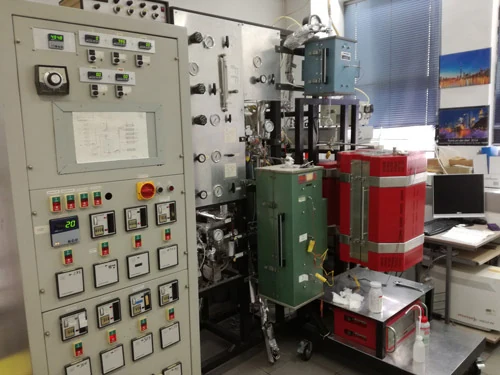
Fixed and fluid bed batch reactor systems for DeNOx and DeSOx studies
The reaction unit consists of the feed gas system, a fixed- and a fluidized-bed reactor, two three-zone furnaces controlled by PID controllers, one for each type of reactor, and the gas analysis system. The fixed- and fluidized-bed reactors are connected in series and can be bypassed by the feed.
Samples from the exit gas stream are analyzed with a series of gas analyzers to identify the gas products during regeneration.
| Typical experimental conditions | |
|---|---|
| Fixed-bed: inlet gas flow rate | 500 ml/min |
| Fixed-bed: reactor loading | 2 g |
| Fluidized-bed: inlet gas flow rate | 1000 ml/min |
| Fluidized-bed: reactor loading | 10 g |
06 · Catalyst Evaluation
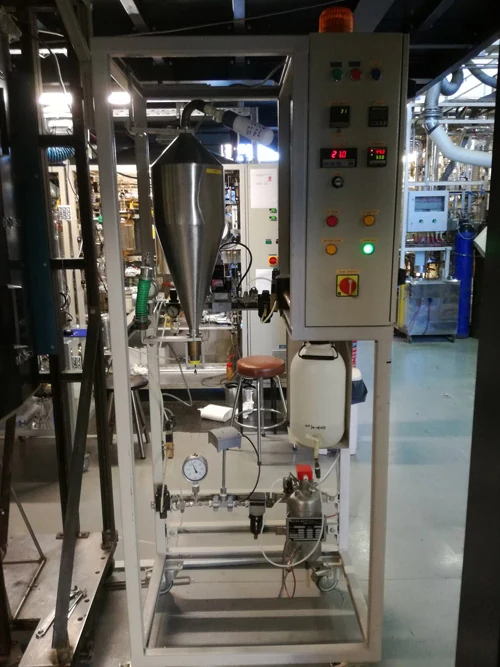
Davison Index (DI) unit for attrition resistance assessment of cracking catalysts
A Davison Index (DI) unit is available in LEFH for the attrition resistance assessment of cracking catalysts.
07 – 10 · Catalyst Evaluation & Biomass
Additional bench scale units
SR-SCT-MAT
Single Receiver – Short Contact Time Microactivity unit for activity and selectivity evaluation of cracking catalysts.
SCT-RT
Short Contact Time Resid Test unit for activity and selectivity evaluation of cracking catalysts in fluid bed configuration utilizing heavier feeds.
ACE
Advanced Cracking Evaluation unit for activity and selectivity evaluation of cracking catalysts in fluid bed configuration.
Biomass flash pyrolysis
A specially designed bench scale unit for catalytic biomass flash pyrolysis studies.